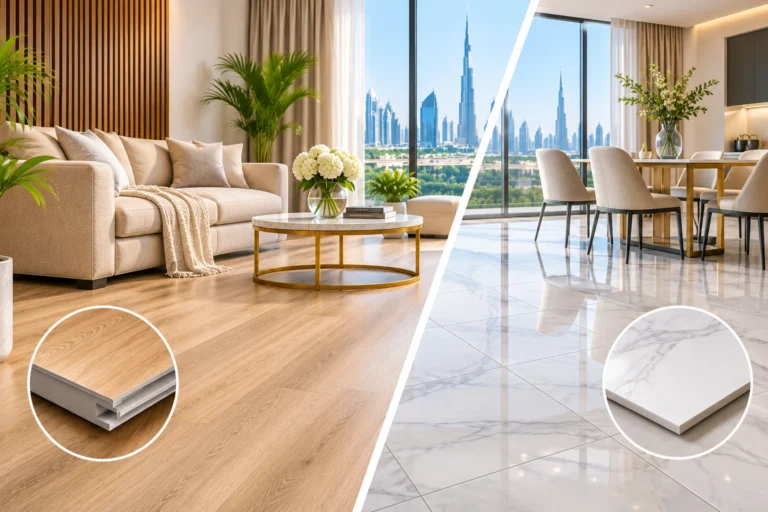
For Dubai homeowners, the SPC flooring vs tiles decision often comes down to durability, maintenance, comfort, installation, and budget. Whilst SPC flooring and tiles are aesthetically pleasing and robust, it can be surprisingly tough to decide on a colour. Unfortunately, flooring is not often replaced due to someone overlooking a key consideration. Dubai property owners often consider which flooring to go for based on aspects such as durability, ease of maintenance, comfort and cost.
SPC flooring is commonly used within Dubai properties (such as living areas, bedrooms and rentals) as it has a waterproof core, can mimic wood and is easy to fit. Porcelain tiles are commonly favoured for bathrooms, outside areas and rooms where high levels of heat and durability are needed. Again, there is no single ‘better’ material – it is about what and how each is used.
What is SPC flooring?
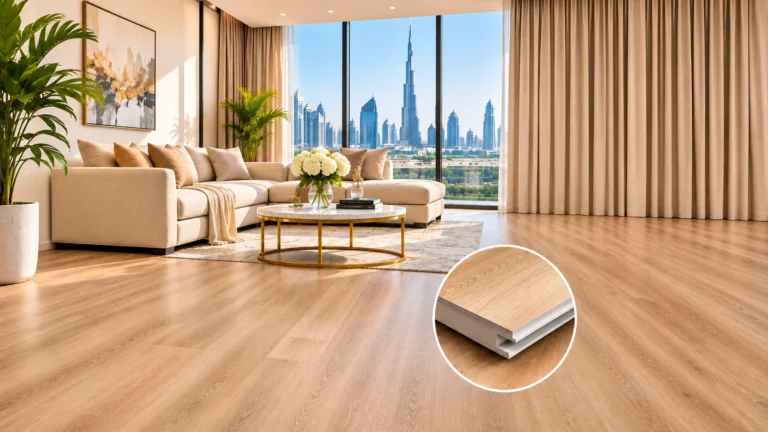
SPC is short for Stone Plastic or Stone Polymer Composite. Typically it is a vinyl composite consisting of mineral compounds (often based on limestone), PVC and various other components. Many SPC flooring planks will have a top layer for extra durability, a middle layer for printing and a firm core.
There may also be an underlay for sound insulation. The firm core ensures structural integrity and the top layer adds further durability. Many Dubai SPC flooring products can also be fitted using a click-fit mechanism onto correctly prepared sub-structures.
What are ceramic and porcelain tiles?
These tiles are made from clay and then fired at high temperatures. Both are hard and robust. Generally, porcelain has superior moisture resistance compared to standard ceramic tiles. Porcelain has a water absorption of 0.5% or less (according to the relevant ASTM testing method). This quality is therefore well suited to areas prone to both moisture and frequent cleaning.
SPC Flooring vs Tiles: Quick Comparison
| Feature | SPC Flooring | Ceramic / Porcelain Tiles |
| Material | Rigid-core vinyl composite | Fired clay-based material |
| Water resistance | Waterproof plank core | Very high for porcelain |
| Scratch resistance | Depends on wear layer | Generally stronger with suitable porcelain |
| Underfoot feel | Firm, sometimes slightly more forgiving | Hard and rigid |
| Installation | Often click-lock | Mortar, adhesive, and grout |
| Cleaning | Sweeping and damp mopping | Easy surface cleaning; grout needs attention |
| Sunlight and heat | Product temperature limits apply | Generally better heat resistance |
| Design options | Wood, stone, and contemporary finishes | Ceramic, porcelain, stone-look, and wood-look finishes |
| Outdoor suitability | Standard indoor SPC generally unsuitable | Suitable exterior-rated tiles available |
1. Which is more durable – SPC flooring vs tiles?
Various areas of Dubai properties, such as hallways, living areas and doorways, are high traffic so durability is an important aspect.
SPC flooring durability: High quality SPC flooring is robust and can withstand normal domestic footfall. As previously mentioned, the top layer can further bolster durability. The firm core also adds structural integrity. Nevertheless, sharp items, furniture and rough sand can all potentially cause marks on the top surface. Despite being robust, SPC is not unbreakable.
Ceramic and porcelain tile durability: High quality porcelain tiles are generally highly durable and hard wearing. They are a good option for high traffic areas such as doorways and kitchens. Yet, tiles can also break or become chipped either from heavy impacts or if the fitting is not adequately supported. Overall, porcelain tends to be superior in terms of hardness and long term durability. However, SPC is still a good option for normal domestic foot traffic.
2. Is SPC flooring more moisture resistant than tiles?
Both are moisture resistant but in differing ways.
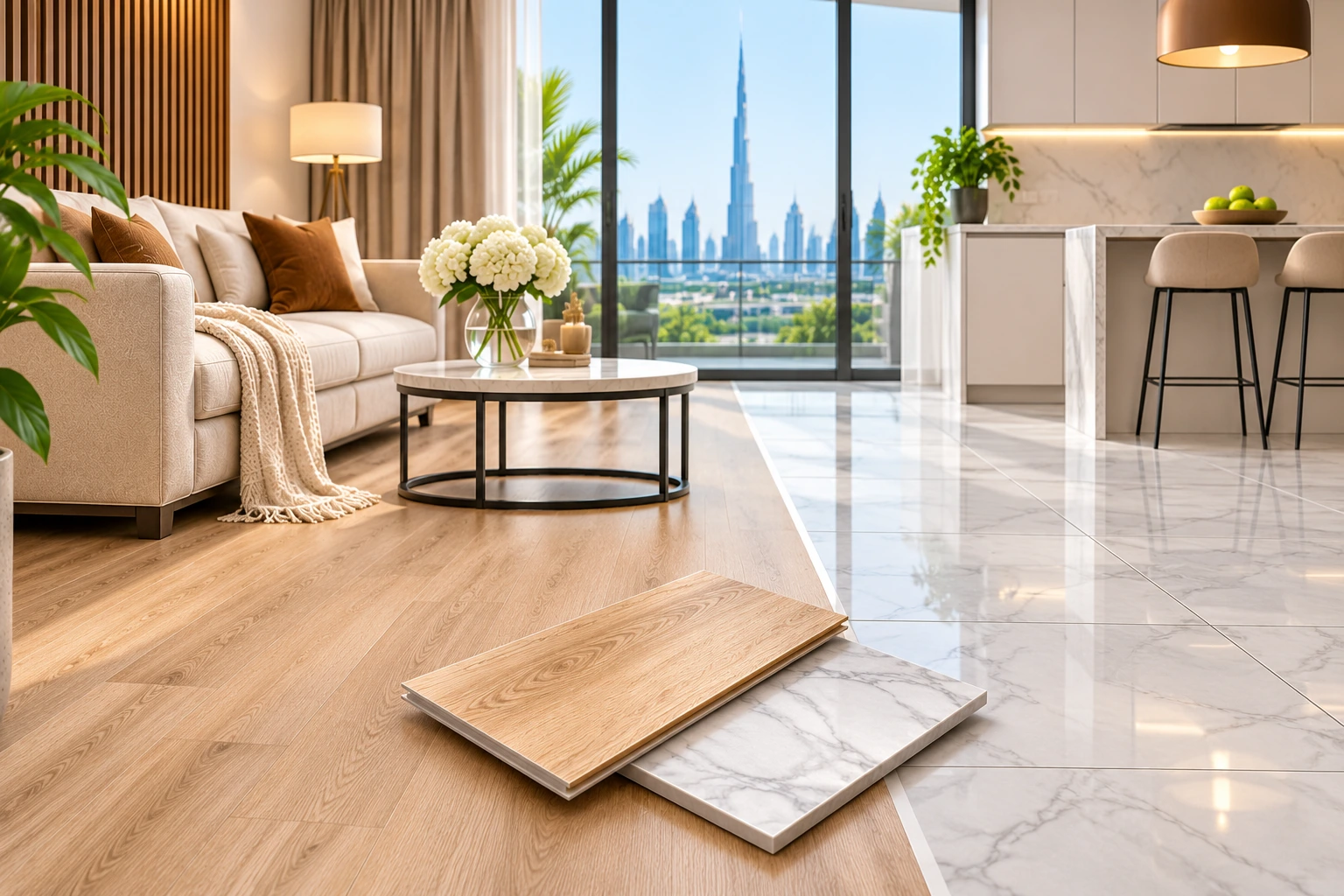
SPC flooring: Unlike conventional wood based laminate, the SPC core is not permeable to water. This helps to avoid warping resulting from common surface moisture issues. Water can, however, seep under click fit SPC flooring via gaps, around the planks and/or through areas where pipes pass through. Note that SPC flooring does not act as a moisture barrier.
Ceramic and Porcelain Tiles: Porcelain is highly moisture resistant. Nonetheless, both the grout and installation still need careful handling. For instance, a bathroom tiled area would require a correctly designed moisture barrier to be fitted under the tiles. Overall, both flooring types have good inherent moisture resistance. But, as a general rule, properly fitted tiles with the right moisture barrier are usually the better choice for constantly moist areas.
3. Which Feels More Comfortable Underfoot?
Whilst this is not usually high on people’s priority list, it can become an issue if you stand or walk around a lot on a new floor. Comparatively, SPC flooring is often less chilly to stand on than ceramic tiles. It may also be marginally more yielding. Despite having a firm core, it can still feel reasonably stiff. Plus, some SPC flooring incorporates an underlay which can help to minimise particular foot fall sounds.
Tiles are stiffer and conduct heat differently. Within Dubai properties with air conditioning, tiles can often be comfortably chilly. However, this may not be ideal for all. For bedrooms and family living areas, SPC can be a good option to achieve a natural wood aesthetic. Tiles continue to be just as viable for kitchens and bathrooms.
4. Is SPC Flooring Easier to fit than tiles?
Depending on the home renovation, this can vary. Many SPC flooring products can be click-fitted and do not need to be fully adhered. Depending on sub-structure suitability, SPC can also be fitted over existing tiles. Tiles are generally adhered using adhesive or mortar. Subsequent activities include cutting, positioning, grouting, and allowing to cure. This can involve more preparation and can be more disruptive.
Nevertheless, SPC flooring is not always straightforward to fit. Appropriate sub-structure, moisture and temperature are highlighted as key considerations in the fitting of SPC by manufacturer Shaw Floors. Generally, SPC is often easier to fit for appropriate renovations. Where possible, it can also be fitted over current tiles.
5. Which flooring is easier to maintain?
Both can be easily maintained. Maintaining SPC flooring: As a rule, SPC flooring can be swept, vacuumed and occasionally damp-mopped. It does not need grout or traditional hardwood floor re-finishing. Yet, again, rough sand and strong cleaning agents can harm the top layer.
Maintaining ceramic and Porcelain Tiles: Tiles are also easy to maintain. Porcelain is largely impervious to common staining. Nevertheless, grout can become dirty and stained over time. Whilst some grout varieties must be sealed, other types have enhanced stain resistance and do not need sealing.
As identified by the Tile Council of North America, the sort of grout used is crucial for both ease of maintenance and stain resistance. Although SPC does not involve cement grout and so often does not need as much maintenance in this respect, SPC flooring vs tiles: which one is generally maintained satisfactorily? Regular maintenance is key.
6. Which flooring offers greater aesthetic scope?
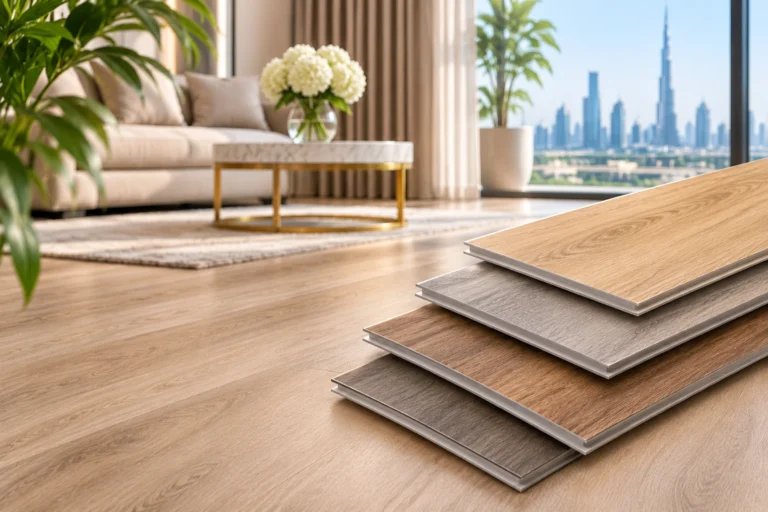
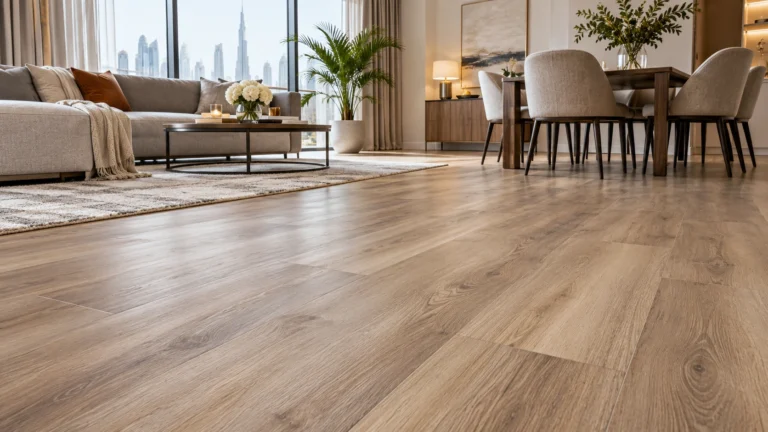
Flooring can impact the visual style of a property. SPC flooring is especially suitable for those wishing to achieve the look of natural wood, without using real wood. Popular options include oak, walnut, grey wood and stone aesthetics. Tiles can additionally display a wider range of surface styles, patterns, dimensions and designs. For example, large porcelain tiles can be used to produce a modern look within larger villas.
Porcelain can also be used to achieve a wood aesthetic – offering the durability benefits of porcelain. In Dubai, people can also blend SPC flooring with modern wall cladding. Or, large format tiles can be combined with plain walls for a cohesive style. Overall, SPC is well suited to natural wood aesthetics. Tiles, on the other hand, offer greater design scope and can also be used to achieve a classic tiling style.
7. Which is best suited to Dubai’s climate?
Both heat and light intensity are high in Dubai so it is important to consider the most suitable materials. SPC flooring is well suited to correctly climate controlled interior areas. However, very bright sunlight can cause excessively high surface temperatures on SPC flooring, particularly if there are large windows. This can in turn result in deformation and/or colour change. Generally, porcelain tiles are better able to withstand both heat and light.
Often, for outdoor areas such as balconies and terraces, outdoor-rated porcelain tiles are a more appropriate choice than standard internal SPC flooring. Nevertheless, outdoor tiles still need to be correctly fitted so as to ensure adequate anti-slip characteristics, water drainage and moisture barriers.
8. Which is more economical in Dubai – SPC flooring vs tiles?
Unfortunately there is no consistently accurate information regarding the comparative costs of SPC and tiles. Many factors will affect the overall cost including the quality of the flooring, the state of the current floor, the room size and fitting needs. Furthermore, SPC can cut fitting and preparation costs if a suitable existing floor can be retained. Often, however, tiles need to be adhered using mortar.
They also need cutting, positioning and grouting – all of which can add to fitting expenditure. Whilst some high end SPC flooring can be costly, basic ceramic tiles are often less expensive.
What Influences Overall Cost?
- Quality and type of flooring
- Floor size
- Current floor stripping
- Sub-structure levelling and moisture preparation
- Fitting labour
- Skirting and capping
- Moisture barriers
- Cutting waste and room configuration
Do not assume that SPC is necessarily always half the cost of tiles. Instead, obtain a detailed quotation. For major renovations, also consider fitting and realistic maintenance and replacement costs.
9. Can tiles be converted to SPC flooring?
Yes. Many times, suitable SPC flooring can be fitted over current ceramic or porcelain tiles. Provided that the original tiles are firmly in place, and the sub-structure is flat, dry and stable to the required degree, this can be achieved. If tiles are in poor condition, the sub-structure is excessively uneven or grout is inappropriate, then preparatory work may be needed.
Those fitting flooring should also ensure that added floor depth does not adversely affect doors, cupboards and cappings. For Dubai apartments and houses, an assessment of the fitting process will usually indicate whether or not the current tiles need to be stripped.
10. What is the most suitable flooring for different rooms?
| Room | Practical Recommendation |
| Living room | SPC for wood-look designs; porcelain for a hard-wearing tiled finish |
| Bedroom | SPC for a wood-look surface; tiles if you prefer a cooler, harder floor |
| Kitchen | Both are suitable with correct specifications |
| Bathroom | Tiles with appropriate waterproofing; selected SPC products only where approved |
| Shower area | Suitable tiles with a complete waterproofing system |
| Hallway | Either, depending on traffic and design |
| Rental apartment | SPC can simplify refurbishment and cleaning |
| Outdoor balcony | Exterior-rated tiles rather than standard indoor SPC |
It is often wise to mix different flooring types, rather than insistently apply one type to all rooms.
What Are the Common Mistakes to Avoid?
Apart from visual appeal, there are several other key areas to consider when selecting flooring. In relation to SPC flooring, avoid fitting it on an uneven sub-structure. Also, ensure that expansion needs are met and that unsuitable flooring is not subjected to excessive direct sunlight. For tiles, assess sub-structure stability, moisture barriers, grout type and anti-slip properties.
Remember, too, that neither waterproof SPC flooring planks nor porcelain tiles constitute a fully waterproof flooring structure in their own right. Specifically, the Tile Council of North America points out that grout is not itself waterproof and that correct fitting procedures and sub-structures are essential for wet areas.
Frequently Asked Questions
Is SPC flooring better than ceramic tiles for Dubai apartments?
SPC can be a good choice for apartments where homeowners want wood-look finishes and convenient installation. Ceramic tiles may be preferable where surface hardness, heat resistance, or wet-area suitability takes priority.
Does SPC flooring last longer than porcelain tiles?
Not necessarily. Quality porcelain tiles can provide a very long service life when installed and maintained correctly. SPC durability varies according to product quality, wear layer, and usage.
Can SPC flooring handle heavy furniture?
Yes, suitable SPC flooring can support normal household furniture. However, concentrated loads and heavy fixed structures may require special installation arrangements.
Is SPC flooring suitable for Dubai bathrooms?
Certain SPC products are suitable for residential bathrooms when manufacturers approve the application. Shower areas and continuously wet zones generally require purpose-designed waterproofing and compatible finishes.
Which flooring is easier to repair?
Both have repair challenges. Damaged SPC planks may require removing connected boards, while damaged tiles require removing grout and adhesive. The repair method depends on the installation.
Is SPC flooring cheaper than porcelain tiles?
SPC flooring vs tiles, can have lower installation costs in suitable renovation projects, but the material and labour prices vary. Compare complete quotations rather than assuming one material always costs less.
Which flooring is safer when wet?
Slip resistance depends on the specific product and surface texture. Neither SPC nor tiles are automatically slip-proof. Request relevant slip-resistance information for bathrooms, kitchens, and other potentially wet areas.
Final thoughts:
SPC flooring and tiles both have a place in modern Dubai homes. SPC makes sense when you want a realistic wood appearance, easy maintenance, a waterproof plank core, and convenient installation. Porcelain tiles are particularly useful when long-term surface durability, heat resistance, or wet-area performance matters most.
For many apartments and villas, combining SPC in living areas with appropriate tiles in bathrooms and outdoor spaces may provide a practical balance. The right choice depends on your property, design preferences, installation conditions, and budget.
Find the Right Flooring With RARE HOME DECOR
Planning to upgrade your apartment, villa, or rental property? RARE HOME DECOR helps Dubai homeowners select practical indoor flooring finishes that suit their interiors and everyday requirements. Explore our SPC flooring services in Dubai or browse our indoor flooring solutions.
Contact RARE HOME DECOR for a free consultation or request a quotation on WhatsApp. Share your room measurements, existing floor details, and preferred finish to receive recommendations for your project.