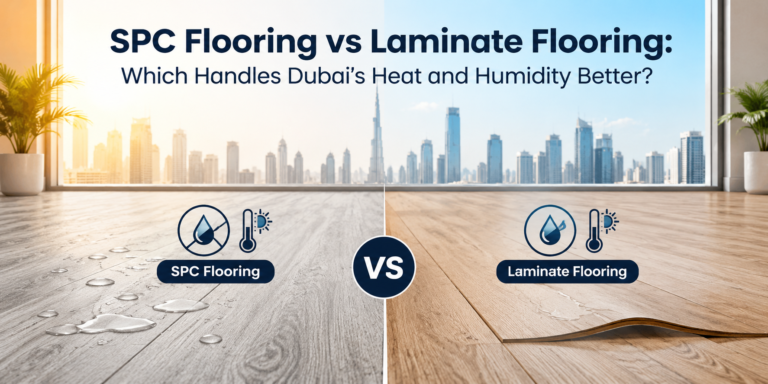
Quick answer: SPC flooring is generally the better choice for Dubai homes. Its stone-plastic composite core is waterproof, resists heat and humidity, and stays dimensionally stable in air-conditioned interiors making it more reliable than laminate, which uses a wood-fiber (HDF) core that’s prone to swelling and warping in moisture.
If you’ve lived in Dubai for more than one summer, you already know what the climate does to a home. The heat outside is one thing, but it’s the combination scorching sun through the glass, air conditioning running nonstop, humidity creeping up for parts of the year, and fine dust settling everywhere that really puts flooring to the test. Picking a floor here isn’t just about which one looks nicer in the showroom. It’s about which one is still flat, tight, and good-looking five years from now.
That’s really what’s behind the SPC vs laminate debate. Both give you that warm, wood-look finish people want, and both go down relatively easily. But underneath the surface, they’re built very differently, and that difference shows up the moment Dubai’s climate gets involved.
Short version: for most homes here, SPC flooring wins because its stone-plastic composite core handles moisture and temperature swings better. Laminate isn’t a bad product, it just needs the right room.
What’s Actually Different About Them
The core is where these two products part ways.
SPC — short for Stone Plastic Composite is a rigid-core vinyl flooring made from limestone or calcium carbonate mixed with PVC and stabilizers. That dense core is what gives it its stiffness and stability, and a wear layer on top handles the everyday scuffs and scratches.
Laminate is built differently: a high-density fiberboard (HDF) core, topped with a printed decorative layer that mimics wood, stone, or whatever finish you’re after, then sealed with a protective layer. Good laminate can look remarkably close to real oak or walnut, which is why it’s still such a popular choice for bedrooms, offices, and living rooms.
That HDF core is fine in the right conditions. But it’s also the reason laminate and Dubai’s climate don’t always get along.
Heat: Who Handles It Better?
Constant heat and sun exposure can make lower-quality flooring expand, contract, fade, or gap over time.
SPC tends to do well here because its rigid core doesn’t move around much compared to wood-based products. That makes it a solid fit for homes where the AC is running most of the day, creating that push-pull between hot air outside and cool air inside.
That said, “heat resistant” doesn’t mean bulletproof. A room with big windows and hours of direct sun will still heat the floor’s surface considerably, so quality materials, proper expansion gaps, correct installation, and some protection from prolonged UV exposure all still matter.
Laminate can handle a climate-controlled room reasonably well too. The bigger risk is its HDF core it’s more sensitive to moisture and swelling, and a cheap product or a rushed install only makes that worse.
Humidity Is Where It Gets Obvious
This is really the deciding factor for a lot of homeowners.
Standard laminate has wood fibers in its core, and wood fibers don’t love moisture. Left exposed to it for long enough, you’ll see swelling, bubbling, or damage along the edges. Even the laminate products marketed as moisture-resistant or waterproof should be checked against the manufacturer’s actual specs the label doesn’t always tell the whole story.
SPC has a clear edge here since its core isn’t wood-based at all. A good-quality SPC floor is generally waterproof and simply doesn’t absorb moisture the way HDF laminate does.
That’s a real advantage during Dubai’s more humid stretches. Bathrooms and consistently wet areas are still a special case, though water can sneak in through poorly sealed joints or a problematic subfloor no matter what flooring sits on top, so the installation quality matters just as much as the material itself.
Does Heat Actually Warp Laminate?
This is a common concern, but heat alone usually isn’t the main problem. A quality laminate floor, installed correctly in a temperature-controlled room, can perform well for years.
Issues are more likely when heat combines with moisture, insufficient expansion gaps, low-quality materials, prolonged direct sunlight, or an uneven subfloor. These factors can increase the risk of swelling, movement, or damage over time.
If your home has large glass windows, receives strong direct sunlight, or experiences fluctuating humidity, SPC flooring offers greater stability and moisture resistance. For homeowners looking for the best flooring in Dubai for homes, SPC is often the safer long-term choice, especially when durability and climate performance are more important than saving on the initial installation cost.
Which One Actually Lasts Longer?
Both can last a long time if you buy quality and take care of them — this isn’t really a case of one being “durable” and the other not.
Laminate’s protective wear layer holds up well against everyday scratches, stains, and foot traffic, and a thicker, higher-quality laminate can genuinely go the distance in bedrooms and living spaces.
SPC combines that same kind of wear layer with a rigid core underneath, which gives it an edge against dents, impact, and moisture on top of the scratch resistance. That combination is why it tends to be the go-to for busy households, rental units, offices, and retail spaces that see a lot of foot traffic.
Maintenance-wise, SPC is refreshingly low-effort sweep, vacuum, damp mop, done without the moisture worries that come with a wood-fiber core.
Quick Comparison
| Feature | SPC Flooring | Laminate Flooring |
|---|---|---|
| Heat resistance | High | Moderate to good, depends on the product |
| Humidity resistance | Excellent | Moderate |
| Waterproofing | Generally waterproof | Depends on the product |
| Moisture sensitivity | Low | Higher |
| Scratch resistance | High with a good wear layer | High with a good wear layer |
| Dimensional stability | Excellent | Moderate |
| Maintenance | Easy | Easy, but moisture needs managing |
| Installation | Click-lock options available | Click-lock options common |
| Best suited for | Dubai homes, high-traffic and moisture-prone areas | Dry, climate-controlled rooms |
| Cost | Moderate | Often more budget-friendly |
So Which Should You Pick for a Dubai Home?
If climate performance is your main concern, SPC is the stronger option overall. The waterproof rigid core, the resistance to swelling and warping, and the durable finish all line up well with what Dubai throws at flooring heat, humidity, dust, and a lot of daily use.
That doesn’t mean laminate is off the table. It still has a place it looks great, costs less upfront, and does perfectly well in dry spaces like bedrooms, studies, or a living room that doesn’t get direct sun. Just be selective about the product and don’t expect it to shrug off moisture the way SPC does.
If you’re after flooring that’s genuinely waterproof and low-maintenance, SPC deserves a closer look.
Thinking Beyond Just the Price Tag
It’s tempting to make this decision on cost alone, but that’s usually short-sighted. Think instead about how the room is actually used — how much sun it gets, how much moisture it’s exposed to, how easy it needs to be to clean, and how long you want the floor to last before you’re redoing it.
SPC often works out cheaper in the long run because you’re not gambling on moisture damage down the line. And with wood-look, stone-look, marble-look, and herringbone styles now widely available, you can get a genuinely premium look without paying for real timber a nice fit for both villas and apartments where practicality and design both matter.
Installation Matters as Much as the Flooring Material
Even the best flooring for Dubai climate can fail when installation is poor.
The subfloor should be clean, dry, stable, and sufficiently level. Installers should follow the manufacturer’s requirements for acclimatization, expansion gaps, underlayment, transitions, and perimeter clearance. Direct sunlight should also be considered when planning plank direction and room layouts.
Professional installation helps prevent common issues such as movement, gaps, uneven joints, and premature wear.
If you are planning a wider interior upgrade, working with a luxury home renovation company in Dubai can also help coordinate flooring with wall finishes, lighting, furniture, curtains, and other design elements for a consistent result.
Conclusion
For homes where heat, humidity, durability, and low maintenance are the priorities, SPC is the more dependable choice its rigid core and waterproof build are simply better matched to Dubai’s climate.
Laminate still earns its place in dry, controlled rooms where budget and aesthetics come first. But if you’re looking for a floor that will handle a busy household, the occasional spill, and a genuinely humid stretch of weather without flinching, SPC is the safer long-term bet especially when it’s paired with proper subfloor prep and a professional install.
At Rare Home Decor, we help Dubai homeowners weigh these trade-offs against their actual space and lifestyle, then handle the sourcing and installation so the floor performs the way it’s supposed to for years, not just on day one.